Some images on this website are created using AI. These images are intended for illustrative and creative purposes only and are not meant to depict or represent any actual person.


Millionaires Made in Los Banos
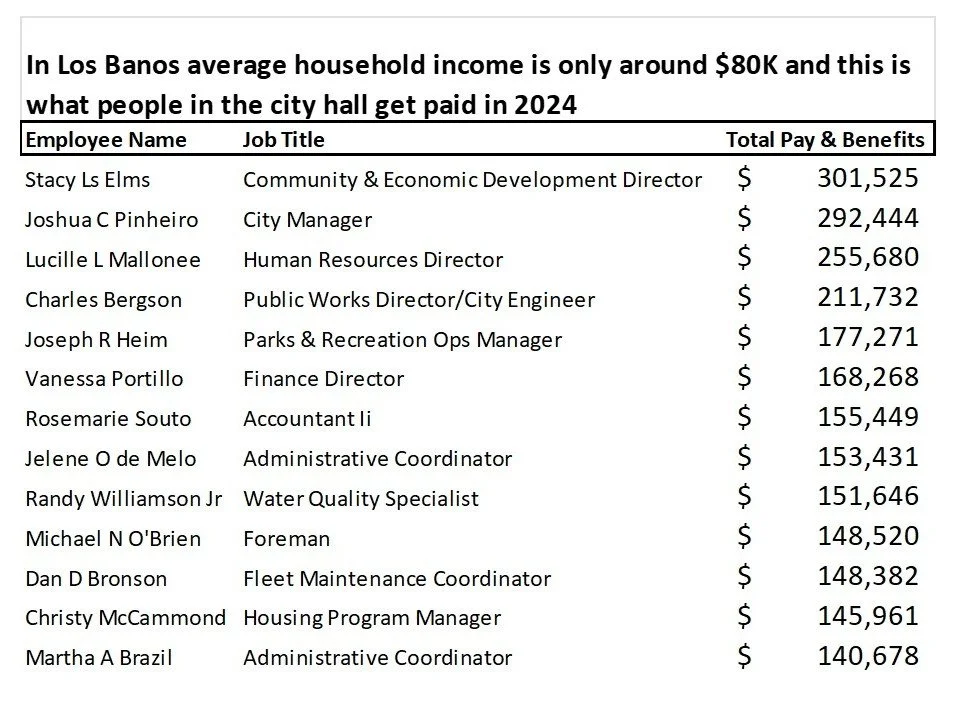
All the details at Transparent California: https://transparentcalifornia.com/salaries/2024/los-banos/
In a reassuring update from Los Banos City Hall, officials confirmed that the Community & Economic Development Director continues to earn a steady $301,000 annually—proof that at least one part of the local economy is thriving.
This comes amid minor background noise such as a sluggish business climate, a noticeable absence of new local jobs, and a median household income in Los Banos hovering below $80,000. But leaders urge residents not to focus on numbers without context.
“Economic development is a long-term strategy,” a spokesperson noted, as another storefront quietly transitioned from “For Lease” to “Still For Lease.”
While small businesses in Los Banos navigate rising costs and constantly fail and residents stretch paychecks that look nothing like $301K, Los Banos City Hall remains confident that high-level compensation is essential to eventually stimulating prosperity—at least at the top.
After all, economic development in Los Banos is clearly working somewhere.
In a continued commitment to “organizational excellence,” the Mayor of Los Banos proudly highlighted the city’s most well-supported residents: senior leadership.
At the forefront is the Los Banos Community & Economic Development Director at $301,000, courageously steering economic vision from a climate-controlled office. Close behind, the City Manager earns $292,000 for the daily challenge of managing meetings about managing the city. Meanwhile, the Human Resources Director, at $255,000, works tirelessly to ensure morale remains highest where it matters most.
While some residents have inquired about potholes, public safety staffing, or park maintenance, City Hall reassures everyone that strong executive compensation is the true foundation of community stability.
“You can’t fix infrastructure without first securing leadership comfort,” a spokesperson explained.
And by that measure, the city has never been stronger.

Los Banos City Hall is a Family Business
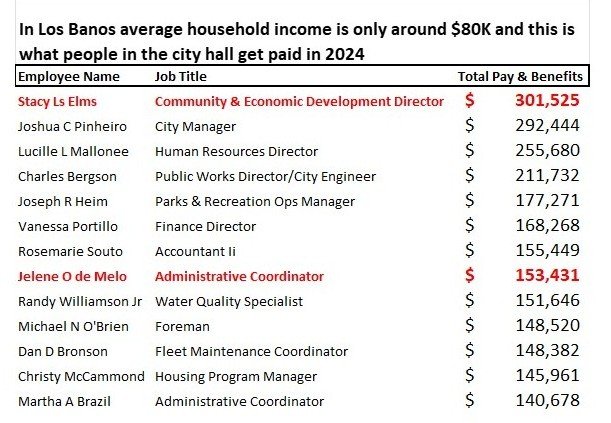
In Los Banos, “Community and Economic Development” has finally reached its purest, most distilled form: family economic development. The Community and Economic Development Director is pulling in over $300,000 a year. And—because every good civic drama needs a sequel—she reportedly helped her sweet sister land an “Administrative Coordinator” role at $153,000.
Now, that title could mean clerical work. Or it could mean a Fortune 500 compensation package, depending on whether the job description includes “Administering the Universe,” “Coordinating the Space-Time Continuum,” or “Politely emailing the Sun to rise on schedule.” Either way, it’s giving main character energy.
And yes—multiple City Hall sources confirm the twist ending nobody saw coming: they’re sisters. Which means, together, they reportedly clear more than $450,000 annually.
“In a town where average household income is about $80,000…”
Plenty of residents are living paycheck to paycheck—stretching groceries, juggling bills, trying to make rent do gymnastics—while the city effectively underwrites this siblings’ economic prosperity like it’s a public works project: “Operation: Prosperity (Family Edition).”
And to be crystal clear: nobody wants anyone breaking rules or sharing anything confidential. But if there’s additional information out there that reveals what other “family enterprises” might be flourishing under the warm glow of municipal service—while Los Banos struggles for everyone not in the inner circle—well… let’s just say the audience is still watching, and the popcorn is not going to butter itself.
Taking money from the homeless

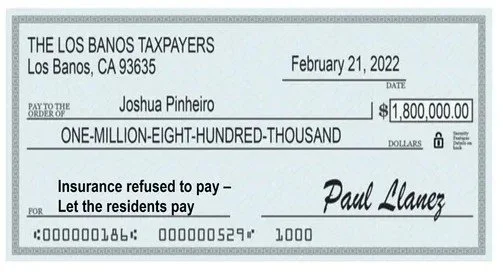
City Manager Takes $1.8 Million Exit as Development Strategy Marches On
In what officials described as a “strategic transition,” the Los Banos City Manager—reportedly a longtime childhood friend of the Community & Economic Development Director—opted for a $1.8 million payout, choosing a graceful exit over what some observers jokingly called “extended public service optimization.”
City Hall framed the payout as fiscally responsible. “It saves the city from years of continued high-level salary obligations,” a spokesperson said, carefully avoiding eye contact with a budget spreadsheet.
Meanwhile, the Community & Economic Development Director, earning $301,000, remains at the helm of an ambitious development agenda. Supporters call it “growth-focused.” Critics describe it less poetically, arguing that rapid housing approvals and developer-friendly policies have helped inflate home prices, strain aging infrastructure, and leave long-term costs for residents to sort out through future taxes and fees.
As new subdivisions rise and roads, water systems, and public services stretch thinner, residents are left wondering whether “economic development” refers to the local workforce—or simply the continued development of executive compensation packages.
Still, City Hall remains optimistic. Leadership may change, payouts may come and go, but one thing is certain: at least some parts of the city’s economy are performing exceptionally well.
Long Commutes, Shrinking Paychecks — and a Very Comfortable City Hall
Across the city, the daily routine has become painfully familiar: residents pack into cars before sunrise, commute hours for jobs outside city limits, and return home to pay mortgages and rents that seem to rise faster than their paychecks. For many households, the grind results in an average income of around $80,000 — earned the long way.
Meanwhile, at City Hall, the local economy appears far more efficient.
The Community & Economic Development Director earns over $300,000 per year, joined by other top city officials whose compensation packages exceed $250,000 annually. While residents juggle layoffs, job scarcity, and housing instability, executive payroll remains one of the city’s most stable growth sectors.
Critics argue that this level of compensation is less about serving the broader public and more about serving those with the most influence — developers, large landowners, and well-connected interests whose projects receive swift approvals and policy alignment. In that view, six-figure salaries are not simply payment for public service, but a reward structure for keeping growth pipelines moving and elite priorities protected.
In neighborhoods across town, families worry about losing homes or downsizing to keep up with rising costs. Small businesses struggle. Local job opportunities remain limited, pushing workers farther away each year just to maintain modest incomes.
City leadership continues to speak about “long-term strategy” and “managed growth.” Residents, however, are left managing commutes, tightening budgets, and wondering when economic development might begin developing something for them.
For now, prosperity appears highly concentrated — and conveniently located within City Hall.