
Some images on this website are created using AI. These images are intended for illustrative and creative purposes only and are not meant to depict or represent any actual person.
Prostitutions is the foundation of Los Banos
The emergence of Los Banos during the late nineteenth century coincided with the expansion of rail infrastructure across California. As a station on the Southern Pacific Railroad, Los Banos developed characteristics common to Western railroad towns: transient populations, male-dominated labor flows, and informal vice economies.
Scholarly studies of the American West confirm that prostitution was widespread in such towns and often tacitly tolerated. Although municipal records in Los Banos rarely address prostitution directly, regional newspaper accounts and oral histories indicate its presence.
Duck hunting provided a socially sanctioned recreational framework. Waterfowl hunting was especially popular among middle- and upper-class men from San Francisco, and rail travel made weekend excursions feasible. Within this context, oral traditions describe a practice whereby men used hunting as a cover for illicit activity, relying on local hunters to supply ducks to preserve domestic credibility.
While such accounts cannot be conclusively verified, they align with broader historical patterns of secrecy shaped by early twentieth-century marital norms, gender expectations, and moral regulation.
“Going Duck Hunting”
In the days when the train whistle echoed across the valley, men boarded railcars in San Francisco with shotguns over their shoulders and excuses on their lips.
They said they were going duck hunting. The train stopped in Los Banos, a town surrounded by marsh and fog and rumor. Some men did hunt. Everyone knew that. The ducks were plentiful, and the land generous.
But others, the old stories say, never made it to the marshes. They found rooms instead—quiet ones, known only by word of mouth. By Sunday evening, when the train carried them home again, they had ducks in hand all the same. Bought. Gifted. Arranged. Back home, their wives cooked the birds and never asked questions.
Whether this happened once or a hundred times no one can say anymore. But the story survived the trains, the hunters, and the houses where the lights once stayed low. In Los Banos, the ducks became proof—not of what happened, but of what could not be spoken.
Transition to the Highway Age
The mid-20th century brought a profound shift. Rail travel declined as automobiles and freight trucking expanded. Interstate 5 reoriented movement through the region, creating new service hubs near interchanges, including Santa Nella. Fuel stations, diners, motels, and rest facilities clustered where long-distance travelers needed to stop. Sociological research on highway systems consistently finds that adult-oriented service economies often appear in such nodes, responding to demand created by long hours, isolation, and anonymity.


Los Banos evolved from whore town to the Drug Corridor
In the 1980s, as the United States intensified its war on drugs, attention focused on borders, ports, and big cities. Yet much of the cocaine and marijuana moving north from Mexico traveled a quieter path—through rural corridors, small airports, and towns that were never meant to be part of an international trade. One of those towns was Los Banos. What happened in Los Banos during that decade was not unique. But the convergence of aviation, highways, secrecy, and selective corruption would leave a mark on the town’s reputation that persists long after the flights stopped.
By the early 1980s, drug traffickers increasingly relied on single-engine aircraft, especially Cessnas, to move narcotics from northern Mexico into California. Flying low to avoid radar and carrying carefully calculated fuel loads, these planes targeted small municipal airports—places with minimal nighttime oversight and little federal presence. Aviation experts and law-enforcement reports from the period noted that parts of California’s Central Valley were reachable from Mexico on a single tank, depending on aircraft configuration and conditions. Los Banos sat within that range. The Los Banos Municipal Airport, modest and lightly trafficked, offered exactly what traffickers needed: darkness, space, and plausible deniability. Planes could land, refuel or offload cargo, and disappear into the night, while the drugs were quickly transferred to vehicles bound for the Bay Area, Southern California, or points north along Interstate 5.
The Role of Silence and Corruption
No illicit network survives without local cooperation. Across the United States during the 1970s and 1980s, federal investigations repeatedly uncovered cases in which individual law-enforcement officers or officials accepted bribes, leaked information, or deliberately looked the other way—particularly in communities where oversight was thin and operations were discreet.
Los Banos was not immune to this national pattern.
Law-enforcement and court records from the era show that cases of corruption and misconduct took place in Central Valley jurisdictions, including instances where officers were investigated, disciplined, or prosecuted for involvement with narcotics or vice-related activities. In small towns, even a handful of compromised individuals can have an outsized impact. Word spreads quickly—among traffickers and residents alike—about which questions won’t be asked and which doors stay closed. This environment of selective silence helped both drug trafficking and prostitution operate in the margins, reinforcing each other through shared protection, shared profits, and shared discretion.
By the 1990s, changes in surveillance technology, aviation enforcement, and trafficking routes reduced the use of small Central Valley airports. Smuggling did not disappear—it adapted elsewhere. But reputations are slower to change than routes. Stories of midnight landings, corrupt cops, and untouchable operations became local lore. Over time, those stories hardened into a simplified narrative: that Los Banos was defined by drugs and prostitution. The reality is much more complicated and the current government and elite members of the town are a big part of it all.


From Prostitutes and Drugs to Cheap Housing Trap
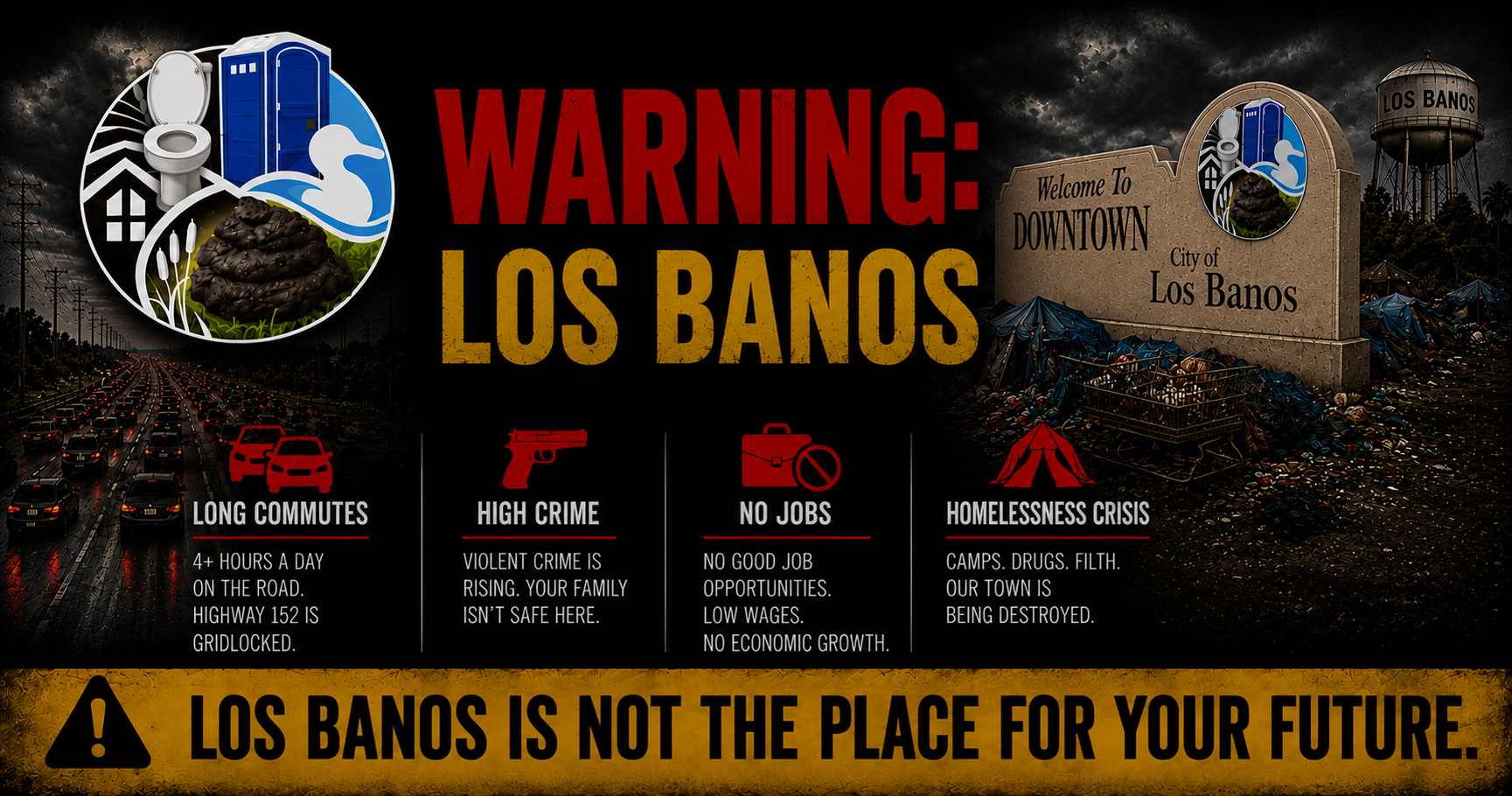
New people came to Los Banos because it was one of the last places they could still afford to buy a home. After years of being priced out of coastal California, the promise of space, quiet streets, and a manageable commute felt like escape. The houses were modest but new, the mortgage lower than rent back west, and the future seemed negotiable again. It didn’t take long to learn what the open houses never mentioned: the tap water wasn’t safe to drink, bottled water became routine, and the air carried dust and chemicals from surrounding fields that settled into homes and lungs alike. These weren’t crises anyone announced—they were conditions people adapted to.
The job stayed two hours away, sometimes more, and the commute slowly consumed everything it touched. Days began before sunrise and ended too tired for much else. While parents were gone, the town offered little for their children—few jobs, few programs, few paths forward. What filled the gap was an underground economy that paid in cash and demanded silence. It started with small favors and quick errands, then drugs, then prostitution for those who ran out of options. Everyone knew where it happened, which motels stayed busy, which trucks lingered overnight. Enforcement came and went unevenly, and survival blurred into complicity.
Leaving proved harder than arriving. Selling meant financial loss; staying meant watching the future narrow. What had looked like affordability revealed itself as deferred cost—paid in health, time, and the lives of kids pulled into systems that thrived where opportunity did not. New families still arrived, drawn by the same numbers that once convinced them, unaware that the real price of cheap living wasn’t listed anywhere, and that once you paid it, there was no easy way back out.